
How to Sleep With Lumbar Spinal Stenosis (Best Sleeping Positions for Less Pain)
By Dr. Jon Saunders, B.Kin., D.C. | Update July 2026
If you have lumbar spinal stenosis, you may notice a frustrating pattern: your symptoms often feel worse first thing in the morning or after lying in bed for several hours.
Maybe your low back feels stiff. Your legs feel heavy, numb, or weak. Or perhaps it takes several minutes of walking before you start to loosen up.
If that sounds familiar, you’re not alone.
While sleeping won’t cure lumbar spinal stenosis, the position you sleep in can make a significant difference in how you feel when you wake up. The right sleeping position may help reduce stress on your lower back, improve comfort throughout the night, and even decrease irritation around sensitive spinal nerves.
In this article, you’ll learn:
- The best sleeping positions for lumbar spinal stenosis
- How to use pillows for better spinal support
- Which sleeping positions may make symptoms worse
- How to get out of bed with less pain
- When it’s time to seek professional help
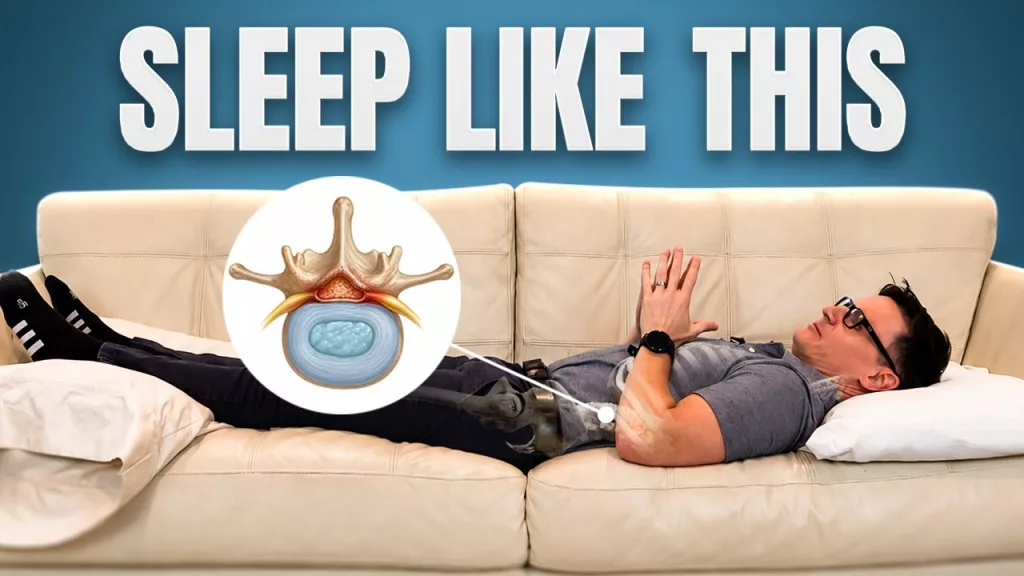
Watch the Video: Learn the best sleeping positions for lumbar spinal stenosis, including pillow placement, mattress tips, and common mistakes that may make your symptoms worse.
Let’s start by understanding why spinal stenosis often feels worse at certain times of the day.
Why Does Lumbar Spinal Stenosis Feel Worse at Night or in the Morning?
Lumbar spinal stenosis occurs when the spaces around the nerves in the lower back become narrowed. This narrowing is most commonly caused by age-related changes such as arthritis, thickened ligaments, disc degeneration, disc bulges/herniations, or bone spurs.
One of the classic signs of lumbar spinal stenosis is this:
Symptoms become worse when standing or walking, but improve when sitting or leaning forward.
Many people notice:
- Low back pain
- Buttock pain
- Leg heaviness
- Numbness or tingling
- Cramping in the calves
- Difficulty walking long distances
- Sciatica
You may have even noticed that leaning on a shopping cart while walking feels surprisingly comfortable. This is often called the “shopping cart sign”, and it’s a common clue that lumbar spinal stenosis may be contributing to your symptoms.
So what does this have to do with sleeping?
For many people, sleeping positions that place the lower back into excessive arching (extension) can increase pressure on already narrowed spaces in the spine. On the other hand, sleeping positions that allow the hips and knees to bend slightly often reduce stress on the lower back and help the muscles relax.
Of course, every person is different, and there isn’t one perfect sleeping position for everyone. However, there are several positions that tend to work well for many people with lumbar spinal stenosis.
Let’s start with the one I recommend most often.
Best Sleeping Position #1: Side Sleeping With a Pillow Between Your Knees
For many people with lumbar spinal stenosis, side sleeping is the most comfortable position.
Why?
When you sleep on your side with your hips and knees slightly bent, your lower back naturally settles into a more comfortable position. This often reduces stress on the joints in the lumbar spine while helping the muscles around the hips and lower back relax.
However, there’s one simple adjustment that can make this position even better.
Place a Pillow Between Your Knees
Without a pillow, your top leg naturally falls forward during the night. This can rotate your pelvis and place unnecessary twisting forces through your lower back.
Placing a pillow between your knees helps:
- Keep your hips aligned
- Reduce twisting through the pelvis
- Support a more neutral spinal position
- Improve overall comfort during the night
A regular bed pillow works well for most people, although some prefer a pillow specifically designed for side sleepers.
A Few Extra Tips
- Bend your knees slightly rather than curling into a tight fetal position.
- Keep your shoulders stacked comfortably.
- If there’s a large gap between your waist and the mattress, a small rolled towel can provide additional support.
The goal isn’t to force your spine into a perfectly straight position. Instead, you’re simply trying to create a comfortable, well-supported posture that minimizes unnecessary stress while you sleep.
Best Sleeping Position #2: Sleeping on Your Back With a Pillow Under Your Knees
If you’re not comfortable sleeping on your side, sleeping on your back is usually the next best option.
However, there’s one important modification that can make a significant difference.
Place a Pillow Under Your Knees
When you lie flat on your back with your legs completely straight, your lower back naturally develops more of an arch. For some people with lumbar spinal stenosis, this increased arch may place additional stress on already narrowed spaces in the spine.
By placing a pillow under your knees, you create a slight bend in your hips and knees.
This simple adjustment can:
- Reduce stress on the lower back
- Help the muscles relax
- Support a more comfortable spinal position
- Improve comfort throughout the night
Many people notice this position feels much more natural than lying completely flat.
How Thick Should the Pillow Be?
A standard bed pillow is usually enough.
The goal isn’t to raise your knees dramatically—it’s simply to create a gentle bend that allows your lower back to relax.
If your knees are pushed too high, the position may actually become uncomfortable, so start with one pillow and adjust based on how your body feels.
Is Stomach Sleeping Bad for Lumbar Spinal Stenosis?
For many people with lumbar spinal stenosis, stomach sleeping is usually the least comfortable position.
That’s because sleeping on your stomach naturally increases the arch in your lower back, placing your spine into more extension.
Remember earlier when we talked about the “shopping cart sign”?
Many people with spinal stenosis feel better when they’re slightly bent forward and worse when they arch backward.
Sleeping on your stomach does the exact opposite.
It often increases the amount of time your lower back remains in an extended position, which may contribute to:
- Increased morning stiffness
- More low back discomfort
- Greater leg pain or numbness
- More difficulty getting moving in the morning
What If You Can Only Sleep on Your Stomach?
If you’ve always been a stomach sleeper, changing positions overnight can be difficult.
Instead of trying to force yourself into an uncomfortable position, start by making a small modification.
Place a pillow underneath your pelvis or lower abdomen.
This helps reduce the amount of arch in your lower back and may improve your comfort while you gradually transition to side or back sleeping.
Small changes performed consistently are often easier than trying to change lifelong habits overnight.
Should You Sleep in a Recliner?
This is one of the most common questions I hear from people with lumbar spinal stenosis.
And the answer is…
Sometimes, yes.
Many people notice they sleep surprisingly well in a recliner.
That’s because reclining naturally places the hips and knees into a slightly bent position while reducing the amount of extension in the lower back.
For some individuals, this decreases pressure on irritated spinal joints and nerves enough to improve comfort throughout the night.
However, I don’t usually recommend relying on a recliner forever.
Sleeping in a recliner for long periods may eventually lead to stiffness, reduced mobility, and discomfort in other parts of the body.
Instead, think of it as a temporary strategy during painful flare-ups while you’re also working on improving your mobility, strength, and overall function.
If you consistently sleep much better in a recliner than in your bed, it’s often a sign that your lumbar spine prefers a slightly flexed position—and that’s useful information to discuss with your healthcare provider.
Does Your Mattress Matter?
Absolutely.
While there’s no single “best” mattress for everyone with lumbar spinal stenosis, your mattress should provide enough support to keep your spine comfortable without creating excessive pressure points.
Generally speaking:
- A mattress that’s too soft may allow your body to sink too deeply, placing additional stress on the lower back.
- A mattress that’s too firm may create uncomfortable pressure over the hips and shoulders while making it difficult for your spine to relax.
For most people, a medium-firm mattress provides the best balance of comfort and support.
More important than the mattress itself is whether you consistently wake up feeling reasonably comfortable.
If your symptoms are always worse after sleeping, it may be worth evaluating both your mattress and your sleeping position before assuming your condition is simply getting worse.
How to Get Out of Bed With Less Pain
Even if you find the perfect sleeping position, how you get out of bed can make a big difference.
One of the most common mistakes people make is sitting straight up from their back.
This places a sudden load on the lower spine when the joints, muscles, and discs have been relatively still for several hours.
Instead, try this simple technique:
Step 1
Roll onto your side while keeping your knees slightly bent.
Step 2
Slide your legs off the edge of the bed.
Step 3
As your legs lower toward the floor, use your arms to gently push yourself into a sitting position.
This “log roll” technique keeps your spine moving as one unit and often feels much more comfortable than trying to sit straight up.
Once you’re standing, don’t rush.
Give yourself a minute or two to walk around the room before starting your day.
Many people with lumbar spinal stenosis find that a few minutes of gentle movement helps reduce stiffness before tackling more demanding activities.
What Should You Do If You Wake Up in Pain?
Even with the best sleeping position, some mornings will simply be worse than others.
Instead of forcing yourself through the pain, try giving your body a few minutes to loosen up.
Many people find relief by:
- Taking a short walk around the house
- Performing a few gentle pelvic tilts
- Bringing one or both knees toward the chest
- Leaning forward onto a kitchen counter for 20 to 30 seconds
- Taking a warm shower to relax stiff muscles
These gentle movements often help reduce stiffness and prepare your body for the day ahead.
The goal isn’t to stretch aggressively.
The goal is simply to get your spine moving comfortably again.
5 Common Sleeping Mistakes With Lumbar Spinal Stenosis
1. Sleeping on Your Stomach Every Night
For many people with lumbar spinal stenosis, stomach sleeping places the lower back into excessive extension for several hours at a time.
If you can’t stop sleeping on your stomach overnight, try placing a pillow underneath your pelvis to reduce the amount of arch in your lower back.
2. Sleeping Without Proper Leg Support
Whether you’re sleeping on your side or your back, proper support matters.
A pillow between your knees when side sleeping—or underneath your knees when back sleeping—can help reduce unnecessary stress on the lower back.
Sometimes a simple pillow adjustment is all it takes to improve comfort.
3. Staying in One Position All Night
It’s completely normal to change positions while you sleep.
In fact, your body naturally does this to reduce pressure on different joints and tissues.
Don’t worry if you wake up in a different position than the one you fell asleep in.
The goal isn’t to stay perfectly still all night.
The goal is to begin the night in a position that places less stress on your lower back.
4. Ignoring Your Morning Symptoms
Your body provides valuable feedback.
If you consistently wake up feeling worse after sleeping in one particular position, it’s worth making a few adjustments.
Changing your pillow, sleeping position, or mattress support may make a noticeable difference over time.
5. Expecting One Position to Solve Everything
Sleeping position is just one piece of the puzzle.
Lumbar spinal stenosis often responds best to a combination of:
- Appropriate exercise
- Walking progression
- Good sleeping habits
- Mobility work
- Strengthening
- Professional care when needed
Think of your sleeping position as one tool that supports your overall recovery—not the entire treatment plan.
When Should You Seek Professional Help?
Home strategies like sleeping position, exercise, and activity modification can make a significant difference for many people with lumbar spinal stenosis.
However, if your symptoms are:
- Becoming more frequent or severe
- Traveling farther down your leg
- Causing increasing weakness
- Affecting your balance or walking
- Limiting your daily activities despite your best efforts
…it may be time for a professional assessment.
It’s also important to remember that not every case of leg pain or numbness is caused by lumbar spinal stenosis.
Sometimes symptoms may be related to:
- A lumbar disc bulge or herniation
- Sciatica
- Hip arthritis
- Sacroiliac joint dysfunction
- Peripheral nerve entrapment
- Vascular conditions affecting circulation
Getting the correct diagnosis is the first step toward choosing the right treatment plan.
Seek immediate medical attention if you develop:
- Loss of bowel or bladder control
- Numbness in the saddle (groin) region
- Rapidly worsening leg weakness
- Severe, unexplained pain following significant trauma
These symptoms require urgent medical evaluation.
How We Help Patients With Lumbar Spinal Stenosis
At Chiropractic on Eagle, we understand that every case of lumbar spinal stenosis is different.
That’s why we don’t simply treat an X-ray or MRI report—we treat the individual sitting in front of us.
Your assessment may include:
- A detailed health history
- Orthopedic and neurological testing
- Postural assessment
- Movement analysis
- Digital X-rays if clinically indicated
- Review of existing MRI or imaging reports when available
Once we understand what’s contributing to your symptoms, we develop a personalized care plan that may include:
- Gentle chiropractic adjustments
- Mobility exercises
- Specific home rehabilitation
- Walking progression strategies
- Postural correction
- Soft tissue therapy
- Lifestyle and ergonomic advice
- Non-surgical spinal decompression therapy for appropriate cases
Our goal isn’t simply to reduce pain.
It’s to help you move better, walk farther, improve your confidence, and get back to doing the activities you enjoy.
The Bottom Line
There isn’t one perfect sleeping position for everyone with lumbar spinal stenosis.
The best position is the one that allows you to wake up with less pain, less stiffness, and better mobility the following morning.
For most people, that means:
✔ Side sleeping with a pillow between the knees
✔ Back sleeping with a pillow underneath the knees
✔ Avoiding prolonged stomach sleeping whenever possible
Combine good sleeping habits with regular exercise, smart activity modification, and appropriate professional care when needed, and you’ll give yourself the best opportunity to improve your comfort and function over time.
Remember, recovery isn’t usually about one magic exercise or one perfect sleeping position.
It’s about consistently making small, smart decisions that help your body move and function better every day.
Ready for More Help?
If you’re struggling with lumbar spinal stenosis and want a personalized plan to help reduce pressure, improve mobility, and walk with greater confidence, we’re here to help.
Our team at Chiropractic on Eagle has been helping patients in Newmarket and the surrounding communities for over two decades using a conservative, evidence-informed approach to spinal care.
Related Articles
If you found this article helpful, you may also enjoy:
- Best Home Exercises for Lumbar Spinal Stenosis (Walk Longer, Hurt Less)
- What Makes Sciatica Worse? (And Why It Isn’t Getting Better)
- VIDEO: Best Home Exercises for Lumbar Spinal Stenosis (Walk Longer, Hurt Less)
Frequently Asked Questions
Chiropractic on Eagle
2:30 – 5:30 PM
2:30 – 6:00 PMTuesday 7:30 – 10:45 AM
2:30 – 5:30 PMWednesday 2:30 – 6:00 PMThursday 7:30 – 10:45 AM
2:30 – 5:30 PMFriday ClosedSaturday ClosedSunday Closed