
Best Home Exercises for Lumbar Spinal Stenosis (Walk Longer, Hurt Less)
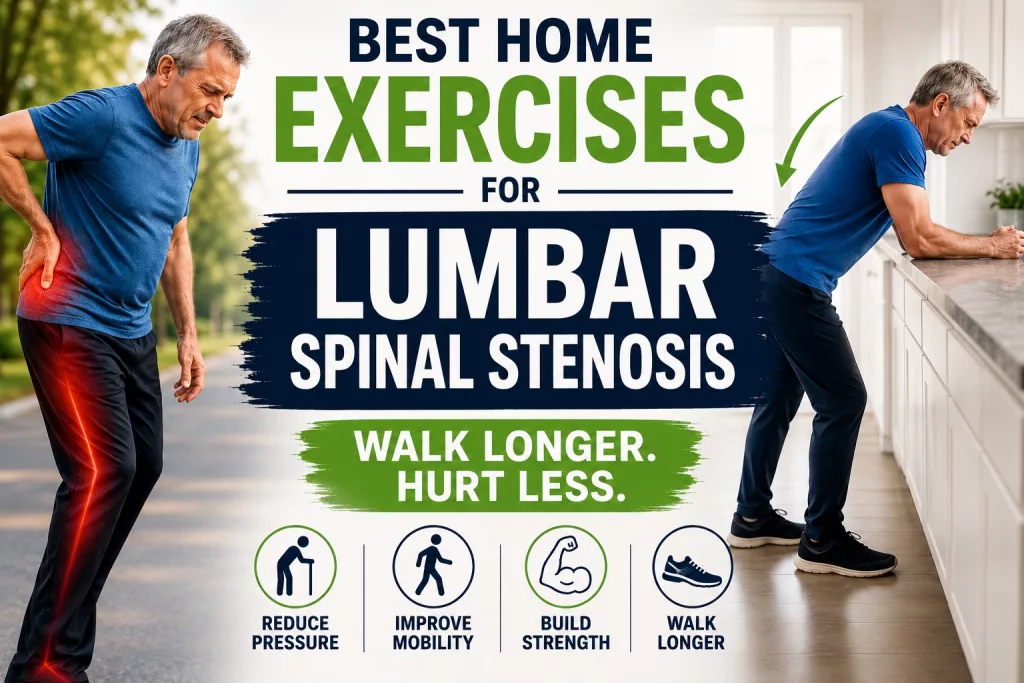
Dr. Jon Saunders, B.Kin., D.C. | Updated July 2026
If you have lumbar spinal stenosis, you may notice a frustrating pattern:
- Standing too long makes your back or legs worse
- Walking too far causes pain, heaviness, tightness, or numbness
- Sitting down often brings relief
- Leaning forward (like on a shopping cart) feels better
Sound familiar?
You’re not alone.
Lumbar spinal stenosis is one of the most common causes of low back and leg pain in adults over 50, and while it can be limiting, the right exercises and habits can often help.
In this article, I’ll walk you through the best home exercises for lumbar spinal stenosis, why they work, and what daily habits can help you move better and walk longer.
[ ▶︎] Watch here: https://youtu.be/RPr9OZXHQeA
What Is Lumbar Spinal Stenosis?
Lumbar spinal stenosis happens when the spaces in the lower spine become narrowed, which can place pressure on the nerves.
This narrowing is often caused by:
- arthritis
- disc degeneration
- disc bulge or herniation
- ligament thickening
- bone spurs
- age-related wear and tear
When this happens, many people develop symptoms such as:
- low back pain
- buttock pain
- leg heaviness
- numbness or tingling
- sciatica
- weakness
- cramping when walking
- needing to sit down frequently
A very common sign is this:
You feel worse standing and walking… but better sitting or leaning forward.
This is often called the shopping cart sign.
Why Exercise Helps Lumbar Spinal Stenosis
Many people think spinal stenosis means they should stop moving.
That’s usually the wrong approach.
The goal is not to “push through pain.”
The goal is to:
✔ Reduce pressure
✔ Improve mobility
✔ Build support
✔ Increase walking tolerance
✔ Stay active without flaring symptoms
The best exercise programs for spinal stenosis usually include:
- flexion-based relief positions
- mobility work
- trunk and hip strengthening
- walking tolerance training
- low-impact aerobic exercise
Let’s go through the best ones.
1. Supported Counter Flexion Stretch
This is one of the simplest and most effective starting points.
How to do it:
Stand facing a kitchen counter or sturdy table.
Place both hands on the surface and slowly step your feet back while pushing your hips backward.
Allow your upper body to lean slightly forward.
Hold for 20–30 seconds.
Repeat 3–5 times.
Why it helps:
This position mimics the same posture many stenosis sufferers naturally seek because it often reduces pressure in the low back and legs.
It’s similar to leaning on a shopping cart.
2. Single or Double Knee to Chest
A classic flexion-based relief movement.
How to do it:
Lie on your back.
Bring one knee gently toward your chest and hold for 15–20 seconds.
Switch sides.
If tolerated, bring both knees in together.
Repeat 3–5 rounds.
Why it helps:
This can help reduce tension and create a more comfortable position for the lower back.
For many people, this feels like a good “reset” exercise.
3. Posterior Pelvic Tilt
This is a simple but important control exercise.
How to do it:
Lie on your back with knees bent.
Gently flatten your lower back toward the floor by tightening your lower stomach and tipping your pelvis backward.
Hold for 3–5 seconds.
Repeat 10–15 times.
Why it helps:
This helps improve low back control, reduce stiffness, and reinforce a position that many spinal stenosis sufferers tolerate better.
4. Short-Range Glute Bridge
Relief is important—but strength matters too.
How to do it:
Lie on your back with knees bent.
Squeeze your glutes and lift your hips slightly.
Hold for 2–3 seconds, then lower.
Repeat 8–12 reps.
Why it helps:
Strong glutes help support the pelvis and low back, which can improve standing and walking mechanics.
5. Walking Intervals or Recumbent Bike
This may be the most overlooked part of recovery.
How to do it:
Start with:
2–5 minute walking intervals OR 5–10 minutes on a recumbent bike
Take short breaks before symptoms become intense.
Repeat as tolerated.
Why it helps:
Walking tolerance is often one of the biggest goals for people with spinal stenosis.
Shorter, more frequent bouts are often much more effective than one painful long walk.
This helps build endurance without excessive flare-ups.
Daily Habits That Help Lumbar Spinal Stenosis
Exercises are only part of the solution.
Your daily habits matter too.
[ ▶︎] Watch here: coming soon
1. Avoid standing in one place too long
Standing still often aggravates symptoms more than moving.
If needed:
- lean on a counter
- shift positions
- sit briefly before symptoms build
2. Walk in shorter, smarter bouts
Don’t force one long painful walk.
Instead:
- walk shorter distances
- take breaks
- repeat more often
This builds tolerance better.
3. Use a slight forward lean when needed
Many people naturally feel better leaning forward.
That’s useful information.
Use it strategically.
4. Avoid aggressive back bending if it makes symptoms worse
Not everyone reacts the same way—but many people with spinal stenosis do worse with repeated extension.
Pay attention to what your body tells you.
5. Don’t become too sedentary
Sitting can help—but too much sitting creates stiffness and weakness.
Use sitting as a reset—not your treatment plan.
When Should You Get Professional Help?
Home exercises can absolutely help.
But if your symptoms are:
- worsening
- traveling farther down the leg
- causing weakness
- affecting your balance
- limiting walking more and more
- or not improving
…it’s time to get assessed.
And if you have:
- bowel or bladder changes
- saddle numbness
- rapidly worsening weakness
seek urgent medical attention.
How We Help Lumbar Spinal Stenosis at Chiropractic on Eagle in Newmarket
At Chiropractic on Eagle, we often help people with lumbar spinal stenosis using a personalized, conservative approach.
Your care may include:
✔ Full chiropractic assessment
✔ Digital X-rays if needed
✔ Orthopedic and neurological testing
✔ Gentle chiropractic adjustments
✔ Mobility and stretching strategies
✔ Specific home rehab exercises
✔ Posture correction
✔ Walking progression strategies
✔ Soft tissue work
✔ Non-surgical spinal decompression therapy
Not every case is the same.
That’s why we focus on finding out what is actually driving your symptoms.
For some people, stenosis is the main issue.
For others, there may also be:
- disc bulges
- nerve irritation
- instability
- or hip involvement
That’s where individualized care matters.
Want More Help With Lumbar Spinal Stenosis?
If you’re struggling with spinal stenosis and want a personalized plan to help reduce pressure, improve mobility, and walk with more confidence, we’re here to help.
Related Articles
If you found this article helpful, you may also enjoy:
- How to Sleep With Lumbar Spinal Stenosis
- What Makes Sciatica Worse? (And Why It Isn’t Getting Better)
- VIDEO: What NOT to Do If You Have Lumbar Spinal Stenosis
Chiropractic on Eagle
2:30 – 5:30 PM
2:30 – 6:00 PMTuesday 7:30 – 10:45 AM
2:30 – 5:30 PMWednesday 2:30 – 6:00 PMThursday 7:30 – 10:45 AM
2:30 – 5:30 PMFriday ClosedSaturday ClosedSunday Closed