
Tension Headache vs Migraine: How to Tell the Difference
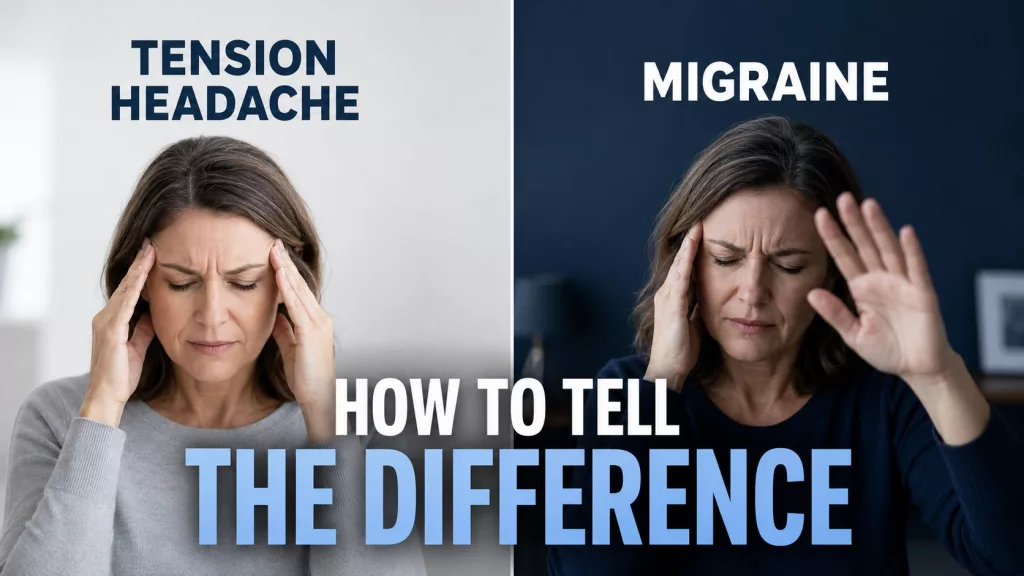
Dr. Jon Saunders, B.Kin., D.C. | Updated August 2026
If you regularly experience headaches, you may notice a frustrating pattern:
- Some feel like pressure around your entire head
- Others throb intensely on one side
- Sometimes your neck and shoulders feel incredibly tight
- Other times you feel nauseated or sensitive to light
- Medication may help temporarily—but the headache eventually returns
Sound familiar?
You’re not alone.
Tension headaches and migraines are two of the most common types of headaches. Although they can sometimes feel similar, they are not the same condition.
And knowing the difference matters.
The triggers, underlying mechanisms, and best treatment approach can be very different.
I understand this firsthand. I suffered from terrible migraines when I was younger, and the help I received was one of the reasons I eventually became a chiropractor.
In this article, I’ll explain the key differences between tension headaches and migraines, when your neck may be contributing, and when it’s time to get your headaches properly assessed.
What Does a Tension Headache Feel Like?
A tension headache usually causes a dull, pressing, or tightening sensation.
Many people describe it as:
- A tight band wrapped around the head
- Pressure across the forehead
- Aching on both sides of the head
- Tightness through the temples
- Tenderness around the scalp, neck, or shoulders
The pain is usually mild to moderate.
You may still be able to work and continue your normal day, although concentrating can become difficult.
Walking, climbing stairs, or performing normal daily activities typically does not make the headache significantly worse.
Despite the name, a tension headache is not always caused by stress or tight muscles alone. It is considered a primary headache disorder, and the exact cause can vary.
However, stress, poor sleep, fatigue, jaw clenching, prolonged sitting, and tension around the head and neck may all play a role.
What Does a Migraine Feel Like?
A migraine is a neurological disorder that can cause much more than head pain.
Migraine pain is often:
- Throbbing or pulsating
- Moderate to severe
- Worse with physical activity
- On one side of the head, although it can affect both
- Present for several hours—or even several days
A migraine may also cause:
- Nausea or vomiting
- Sensitivity to light
- Sensitivity to sound
- Sensitivity to smells
- Dizziness
- Fatigue
- Difficulty concentrating
- A strong need to lie down in a quiet, dark room
Some people also experience a migraine aura.
This may include flashing lights, blind spots, zigzag patterns, tingling, or difficulty finding the right words.
However, most migraines occur without an aura.
Tension Headache vs Migraine: Key Differences
| Feature | Tension Headache | Migraine |
|---|---|---|
| Pain | Dull, tight, pressure | Throbbing or pulsing |
| Location | Usually both sides | Often one side |
| Intensity | Mild to moderate | Moderate to severe |
| Nausea | Rare | Common |
| Light sensitivity | Usually absent | Common |
| Sound sensitivity | Usually absent | Common |
| Physical activity | Doesn’t usually worsen pain | Often makes pain worse |
| Duration | 30 minutes to several hours | 4–72 hours |
These are common patterns—not a diagnosis.
Headaches don’t always follow the textbook, and some people experience more than one type.
Five Questions That May Help You Tell the Difference
If you’re not sure which type of headache you have, ask yourself these five questions.
1. Is the pain pressing or throbbing?
Tension headaches are more likely to feel like pressure, aching, or tightening.
Migraines are more likely to throb or pulse.
2. Does normal activity make it worse?
Walking, bending, climbing stairs, or performing other routine activities generally does not aggravate a tension headache.
With a migraine, even simple movement can make the pain worse.
3. Do you feel nauseated?
Nausea or vomiting is much more suggestive of a migraine than a tension headache.
4. Are you sensitive to both light and sound?
Migraines commonly cause sensitivity to both.
A tension headache may occasionally cause sensitivity to light or sound—but usually not both at the same time.
5. Can you continue your normal day?
Many people can continue working through a tension headache, even though it may affect their comfort and concentration.
A migraine is much more likely to stop you in your tracks and make you want to lie down somewhere quiet and dark.
Could Your Neck Be Causing Your Headache?
Yes—and this is where things can become confusing.
A headache that originates from the joints, muscles, or other structures in the neck is known as a cervicogenic headache.
Common signs include:
- Pain beginning in the upper neck or at the base of the skull
- Reduced or painful neck movement
- Head pain triggered by certain neck positions
- Pain that repeatedly occurs on the same side
- Tenderness in the upper neck
- Pain travelling into the temple, forehead, or behind an eye
- Headaches that worsen after prolonged sitting or computer work
A cervicogenic headache can sometimes feel like a tension headache. In more severe cases, it may even feel migraine-like.
However, neck pain alone does not prove that your headache is coming from your neck.
Many people with migraines also experience neck pain or stiffness before or during an attack. That’s why we need to look at the entire pattern—not just one symptom.
You can learn more about cervicogenic headaches and how the neck can refer pain into the head.
What Commonly Triggers Tension Headaches?
Common aggravating factors include:
- Mental or emotional stress
- Fatigue
- Poor sleep
- Prolonged computer work
- Sustained or awkward postures
- Jaw clenching or teeth grinding
- Eye strain
- Skipping meals
- Dehydration
- Tenderness in the scalp, jaw, neck, or shoulder muscles
Usually, it isn’t just one thing.
For many people, headaches become more likely when several of these factors build up at the same time.
You’re tired. You’ve been sitting at a computer all day. Your shoulders are creeping upward. You’re clenching your jaw without realizing it.
Eventually, your body lets you know that something needs to change.
What Commonly Triggers Migraines?
Migraine triggers can be very different from one person to another.
Common triggers include:
- Changes in sleep
- Hormonal changes
- Stress—or the period immediately after stress
- Skipping meals
- Dehydration
- Alcohol
- Bright or flickering lights
- Strong smells
- Weather changes
- Certain foods
- Too much caffeine
- Caffeine withdrawal
When I experienced migraines in my younger years, weather changes and fatigue were two of my biggest triggers.
But it’s important to understand the difference between a trigger and a cause.
Migraine is a neurological disorder. A trigger is simply something that may help set off an attack in someone who is already susceptible.
Can Stress Cause Both Types of Headaches?
Yes.
Stress can contribute to tension headaches, but it can also trigger migraines.
The symptoms that follow often provide the best clue.
Stress followed by dull pressure around both sides of the head is more suggestive of a tension headache.
Stress followed by throbbing pain, nausea, light sensitivity, and pain that worsens with movement is more suggestive of migraine.
So, there can certainly be some overlap.
What About Pain Behind the Eyes?
Pain behind one or both eyes can occur with several different headache conditions.
These may include:
- Migraine
- Cervicogenic headache
- Tension headache
- Cluster headache
- Eye strain
- Sinus or eye conditions
The location of the pain alone is not enough to identify the cause.
For example, a problem originating in the upper neck can sometimes refer pain toward the forehead or behind an eye. A migraine can cause intense pain in the exact same area.
The other symptoms—and what makes the pain better or worse—often tell us much more.
What Can Help a Tension Headache?
The best approach depends on what is contributing to the headache.
Helpful strategies may include:
- Taking regular movement breaks
- Gentle neck and shoulder mobility
- Specific neck-strengthening exercises
- Improving your workstation setup
- Relaxation or breathing exercises
- Maintaining a regular sleep schedule
- Avoiding skipped meals
- Addressing jaw clenching
- Heat or gentle massage
- Chiropractic Care
- Getting assessed if the headaches keep returning
One mistake people often make is relying on pain medication every time a headache appears without investigating why the headaches are happening so frequently.
Medication can certainly be helpful when used appropriately. However, frequent use can sometimes contribute to medication-overuse headaches.
Can Chiropractic Care Help With Headaches?
It depends on the type of headache and whether the neck is part of the problem.
Some people with migraines also have neck stiffness, restricted spinal movement, muscle tenderness, or a separate cervicogenic headache component.
For tension-type and cervicogenic headaches, a conservative treatment plan may include:
- Gentle spinal mobilization or adjustment
- Soft-tissue treatment
- Posture correction
- Neck and upper-back exercises
- Ergonomic changes
- Advice about movement and daily activities
Research suggests that specific exercises may help tension-type and cervicogenic headaches. Manual therapy is also be considered as part of a broader treatment plan when appropriate.
The first step is determining what type of headache you are actually dealing with.
How We Assess Headaches at Chiropractic on Eagle
At Chiropractic on Eagle in Newmarket, we begin by listening.
We want to understand when your headaches started, what they feel like, where the pain travels, and what seems to trigger them.
Depending on your symptoms, we may assess:
- The location and duration of your headaches
- Neck movement
- Upper cervical joint function
- Muscle and scalp tenderness
- Posture
- Neurological function
- Previous neck or head injuries
- Jaw tension
- Headache triggers
- Warning signs that require medical referral
Not every headache comes from the neck. However, the neck usually contributes to many types of headaches.
And not every person with headaches should receive the same treatment.
Our goal is to determine whether a mechanical problem in your neck may be contributing and whether conservative care is appropriate for you.
The Bottom Line
Tension headaches and migraines can overlap, but there are some important differences.
A tension headache is more likely to cause:
- Dull, pressing, or tightening pain
- Pain on both sides of the head
- Mild to moderate discomfort
- Little or no worsening with normal activity
- No nausea or vomiting
A migraine is more likely to cause:
- Throbbing or pulsating pain
- Moderate to severe pain
- Nausea
- Sensitivity to light and sound
- Pain that worsens with activity
- A need to stop what you’re doing and rest
- Dizziness and other neurological symptoms
And if your headaches repeatedly begin in your upper neck, change with neck movement, or worsen after prolonged postural strain, your neck may also need to be assessed.
The goal isn’t simply to put a name on your headache.
The goal is to understand the pattern, rule out anything serious, and choose the right treatment approach.
Ready for More Help?
If you experience frequent headaches along with neck pain, stiffness, reduced movement, or posture-related strain, we’re here to help.
At Chiropractic on Eagle, we have been helping patients in Newmarket, Aurora, East Gwillimbury, Bradford, and the surrounding communities for more than two decades.
Our approach is conservative, personalized, and focused on determining whether neck dysfunction may be contributing to your headaches.
Related Articles
If you found this article helpful, you may also enjoy:
- Cervicogenic Headache Relief in Newmarket
- Tension Headache Relief in Newmarket
- Migraine Relief in Newmarket
- Headache Treatment in Newmarket
- VIDEO: Best Exercises for Tension Headaches | 5-Minute Follow Along
Frequently Asked Questions
Chiropractic on Eagle
2:30 – 5:30 PM
2:30 – 6:00 PMTuesday 7:30 – 10:45 AM
2:30 – 5:30 PMWednesday 2:30 – 6:00 PMThursday 7:30 – 10:45 AM
2:30 – 5:30 PMFriday ClosedSaturday ClosedSunday Closed